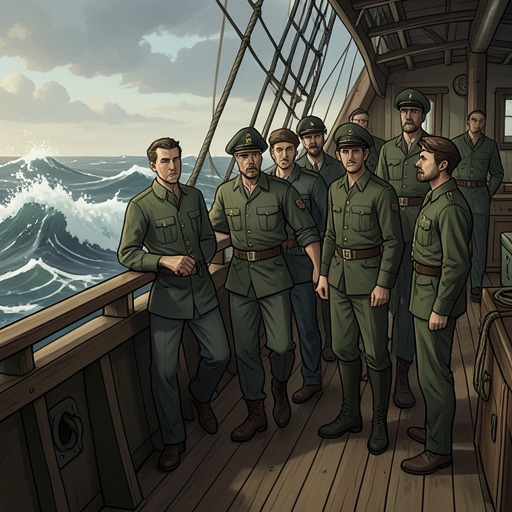
Keefer abandons the Caine
The Caine Mutiny Court-MartialTom Keefer abandons the Caine during the crisis that follows explosions aboard the ship. His decision turns a scene of damage and confusion into a decisive contrast: Keefer assumes the ship cannot be saved and leaves, while Willie Keith stays and asks to help control the fire. The episode makes the difference between declaring a ship lost and acting to preserve it visible in the crew’s immediate response.
The Decision to Abandon Ship
Keefer first proposes that the word be passed to abandon ship. He is visibly unwell, and says that his arm feels badly hurt and that he may have been struck by a piece of a shell. Despite this condition, he gets to his feet, staggers into the wheelhouse, and reaches for the public-address system. Using it, he announces that all hands are to abandon ship. The order gives his judgment immediate force: rather than confining his conclusion to a private assessment, he broadcasts it to the crew as an instruction.
Keefer then comes out of the wheelhouse as another explosion in the smoke around the deckhouse sends metal rattling against the bridge and a blast of heat across it. He declares that the ship will not survive much longer and points to sailors in the water as evidence that men are already leaving from aft. In the rush that follows, officers and sailors jostle toward the rail. The scene’s urgency grows not just from the damage, but from the way Keefer’s announcement and interpretation of what he sees turn into a mass movement toward the water.
Willie Keith Challenges His Reading
Willie Keith, however, is looking toward the aft part of the ship and disputes Keefer’s account. He tells him that nobody is jumping from aft: the men visible in the water came from the bridge. The distinction matters because Keefer treats the swimmers as proof that the main deck is being lost, while Willie identifies their actual point of departure. His correction challenges the basis for Keefer’s certainty, but does not stop the evacuation already under way.
Keefer pays no attention to Willie’s warning. With a canvas sack in his uninjured arm and his other arm bloodstained, he continues carefully toward the bulwark, favoring the injured side. Willie grabs his shoulder as he leans out to jump. Rather than follow the crowd, Willie requests permission to remain aboard with volunteers and attempt to get the fire under control. His request places a different possibility beside Keefer’s conclusion: the situation may be dangerous, but there is still work to be done on the ship.
Keefer Goes Over the Side
Willie’s appeal briefly registers with Keefer, but Keefer responds as though staying aboard were an unreasonable choice. He tells Willie that he cannot prevent him from committing suicide, then leaps outward and falls into the water. Keefer’s departure completes the reversal between the men: the officer who had just used the public-address system to direct everyone else to abandon ship now leaves the Caine himself, while Willie remains at the rail after expressly asking to stay.
The scene does not show Keefer persuading Willie or accepting his offer to organize volunteers. Instead, Willie’s attempt to stop him ends with Keefer in the water and heads bobbing around him. The remaining figures on the bridge are Willie and Ensign Farrington, who is leaning against the flagbag and wiping his eyes. Willie turns his attention to Farrington with a blunt challenge about what is keeping him back. The ending thus leaves the question of who will stay aboard open as an immediate test of action, rather than resolving the fire or the ship’s fate within Keefer’s departure.
Significance of the Contrast
Keefer’s order is consequential both as a command and as a judgment about the Caine’s prospects. He speaks through the public-address system in the captain’s voice, but Willie’s correction shows that Keefer’s interpretation of the crew’s movements is mistaken. The scene does not establish that Keefer deliberately misrepresents what he sees; it does show that his conviction that the ship is doomed persists after Willie challenges his evidence. His physical injury and the explosions form the urgent circumstances of his decision, while his refusal to reconsider leaves the decision untested by the alternative Willie proposes.
For Willie, the episode becomes a choice between joining the evacuation and remaining to help. He does not claim that the ship is safe or that the fire can certainly be controlled; he asks to stay with volunteers and try. That modest wording gives his response its force. Keefer treats departure as unavoidable, whereas Willie treats continued effort as possible even under uncertain conditions. The event therefore marks a sharp difference in conduct at the moment when the crew is leaving the ship: Keefer abandons the Caine, and Willie stays long enough to challenge another officer to do the same.